One 77-year-old’s search for the truth: 9/11, election fraud, illegal wars, Wall Street criminality, a stolen nuke, the neocon wars, control of the U.S. government by global corporations, the unjustified assault on Social Security, media complicity, and the "Great Recession" about to become the second Great Depression. "The most important truths are hidden from us by the powerful few who strive to steal the American dream by keeping We the People in the dark."
Showing posts with label Occupy Wall Street. Show all posts
Showing posts with label Occupy Wall Street. Show all posts
American Autumn: An Occudoc (Watch Free Full-Length Feature Film)
Excellent new documentary on the Occupy movement from my friend / key organizer / kick ass filmmaker @DennisTrainorJr…
“Shot
on the front lines and meeting spaces of the Occupy movement in NYC,
Boston, and Washington, DC from the earliest days through the end of
January 2012 American Autumn: an Occudoc is an inside looking out view
of the occupy movement.
With interviews and insight from key organizers, thinkers and activists
including Medea Benjamin, David DeGraw, Dr. Margaret Flowers, Lee Camp,
Naomi Klein, Nathan Schneider, Ashley Sanders, Vlad Teichberg, Sgt.
Shamar Thomas, Dr. Cornel West, Kevin Zeese and many more. Writer/
director Dennis Trainor Jr weaves commentary and a fearless style that
often puts the viewer right between police and protesters.”
Former Labor Sec. Robert Reich on Clinton’s Errors of Crippling Welfare to Repealing Glass-Steagall
Former Secretary of Labor Robert Reich critiques President Obama’s handling of the economic crisis and the Clinton administration’s repeal of the Glass-Steagall Act, a key deregulatory move that ended the separation of commercial and investment banking and is widely seen as having helped lead to the financial collapse. The Clinton administration also presided over a drastic transformation of U.S. welfare laws, throwing millions off of welfare rolls. "I went outside of the White House, walked back to my office along Constitution Avenue, expecting I would see signs. ... There are a lot of people who were concerned about that issue. But there was nobody on the streets. It was deafening. The silence was deafening," Reich says of the day Clinton signed the change into law. He notes this is when he realized, "if people who are concerned about the increasing concentration of wealth and power in this country are not mobilized, are not visible, then nothing progressive is going to happen." Reich is professor of public policy at the University of California at Berkeley. He has written 13 books, including "Aftershock: The Next Economy and America’s Future." His latest, an e-book, is just out: "Beyond Outrage: What Has Gone Wrong with Our Economy and Our Democracy, and How to Fix Them." [Original includes rush transcript]
"We Need to Make a Ruckus": Robert Reich Hails Occupy for Exposing Concentration of Wealth and Power
In his new book, "Beyond Outrage," former Labor Secretary Robert Reich opens with a dedication to the Occupy Wall Street movement. He writes: "To the Occupiers, and all others committed to taking back our economy and our democracy." We speak to Reich about the success of Occupy in reshaping the national dialogue on the economy and why strong grassroots movements are needed to push elected leaders in Washington to enact a progressive agenda. Reich also discusses why austerity is not the answer to the economic crisis at home or in Europe. [Original includes rush transcript]
All over the world, May 1st is celebrated as
International Workers Day. Yesterday, May Day also marked the
reemergence of the Occupy movement, with events in cities all over
America. AlterNet's reporters were in the field -- here are their
dispatches from New York and the Bay Area.
Midtown NYC, morning
-- Sarah Jaffe
Midtown is a great place for chanting; your voice echoes off the tall
buildings and you can hear it blocks away. Even better for marching
bands, bells and whistles. There may not actually be 99 pickets, but
midtown Manhattan is clogged with them in the morning, and they're
inside the heads of the people on the street--I walk past a couple
discussing our "cruel," unequal society as I hurry from picket to
picket.
I made it to Bryant Park a few
minutes after eight in a haze of rain, and found a crowd of around a
hundred huddled under their umbrellas or the ones at tables in the park.
The Rude Mechanical Orchestra were clustered around their instruments
but not playing, and Occupiers chatted with one another.
My first picket stop was at the New
York Times building, where the United Auto Workers (UAW) were picketing
under a lovely awning in support of the National Organization of Legal
Services Workers, (UAW Local 2320). The lawyers and legal support staff
of Legal Services NYC provide free legal aid to New York's low-income
folks who need support--they help fight evictions, support the
unemployed, work on benefits for the disabled, and more. And they're
facing cutbacks from their board, who want them to give back part of
their healthcare benefits--not to mention cuts to the services they
provide. "We make next to nothing," a legal services worker told me,
pointing out that her benefits allow her to do a low-paid service job
and take care of herself and her family. Meanwhile, none of the cuts
have hit management. Their target for the day's picket was Michael
Young, the vice chair of the Board of Directors at Legal Services NYC,
who has been the point person in negotiating with the union.
As we stood talking, the Rude
Mechanical Orchestra and a small march rolled in, playing "Which Side
Are You On?" and thrilling the workers, who didn't seem terribly
connected at first to the larger May Day celebrations. The picket line
turned into a dance party, and the band played along with chants of "Hey
hey rich boy, my job is not your toy" and "We're legal services for the
poor, fired up won't take no more."
From Twitter, colleagues Allison
Kilkenny, John Knefel and I heard reports of arrests at the Bank of
America tower, which was surrounded by barricades when we arrived but
quiet at the moment, so I moved on to News Corp headquarters--where the
ticker outside the building warned "Occupy plans to shut down city
today, gathering at Bryant Park". It made a lovely backdrop for the
lively picket line, featuring several members of OWS's Direct Action
working group as well as banners and activists from Picture the
Homeless, SEIU, VOCAL-NY (includingWayne Starks, who I spoke with on Tax Day), and other local groups.
As they marched, the crowd repeated
the crimes of Rupert Murdoch and News Corp--not only "Murdoch spies," a
reference to the phone hacking scandal in the UK, but "News Corp called
for closing HIV food pantries, housing for people with AIDS."
From News Corp, I moved on to
Chase, where a small but determined band was chanting "Save our homes,
modify loans!" outside the branch on 47th and Madison, but no one had
made it to the main headquarters, location of many an Occupy event, yet.
I saw a march rounding the corner as I headed the other way, trying to
catch a march that had left News Corp for the headquarters of the
Paulson Group, one of the world's largest hedge funds, but instead I
crossed paths with a small march flying an anarchist flag, singing
"Ain't no power like the power of the people because the power of the
people don't stop."
The marchers were young, mostly
white, but the one arrest came when a young black man, whose name, I was
told, was Gregory Walker, was slammed against a glass window and thrown
to the ground--I didn't see what happened to cause his arrest, but I
did watch him loaded into a police van and the crowd spontaneously broke
into "Solidarity Forever."
Back at Bryant Park, the scene
had picked up and the feeling was more Liberty Square than grim
determination. A woman mic-checked to offer belly dance lessons, and I
chatted with Betsy Fagin at the Library, back in action. Screenprinters
had the next table over from the Library, and were churning out prints
of a Guy Fawkes mask decorated with spring leaves. I caught up with Pam
Brown and Suzanne Collado of the Occupy Student Debt campaign, who had
been at their own picket outside of NYU, protesting student debt and the
university's expansion plan (financed, of course, with students'
money).
The park is also serving as a
staging location for marches--I spoke with organizers pulling together
an immigrant worker justice march, departing at 11 to his Praesidian
Capital, Wells Fargo, the Capital Grille, Chipotle and Beth Israel, in
support of workers trying to organize, Wells's support for
anti-immigrant legislation through ALEC, wage theft and discrimination,
the Coalition of Immokalee Workers' Fair Food Campaign, and laundry workers who clean hospital sheets, respectively.
On the way out, I spoke with
Jerry, who told me about the Summer Disobedience school that will be
held every Saturday in Bryant Park, training activists in pickets,
marches, street theater, and much more.
Wildcat Strike -- NYC
-- Anna Lekas Miller
The Wildcat Strike --
designed to bring together non-unionized, or unionized workers whose
unions had not approved the strike -- was one of the unpermitted actions
of May Day. Protestors and strikers came at the risk of their own
arrests and the authorities had the right to "do whatever they want."
I arrived at Sara Roosevelt Park half an hour early--there were
already fifty or sixty police huddled on the corner of 2nd Avenue and
East Houston. At that point, there were maybe ten protestors.
"I feel like they're the ones that should be protesting and we should
be the cops," I joked to one of the few other protestors in the park.
"I know. I wish we could pull out our batons and tell them that they're blocking the sidewalk," he replied.
A few minutes later, fellow protestors and marches streamed in from
Brooklyn, fresh from having walked across the Williamsburg Bridge. To my
surprise, the police began to subside, merely observing the
demonstrators as they played music, held signs and chanted.
Though the crowd was mostly young and though not exclusively white,
far from racially diverse, their occupations -- and reasons for showing
solidarity at the wildcat march in particular -- were vastly different.
"I am a not union metal worker, working a pretty low range for my
skill set," said Rachel, a young woman holding a foil flag as an
artistic allude to metal workers. "I'm here to represent those who are
actually in labor who don't want to be part of a permitted
anti-capitalist march and stand in solidarity with my fellow workers who
might be afraid or can't afford to be here."
Gregory, a doctoral student and graduate teaching assistant at SUNY
Stony Brook College also came to use the wildcat strike as an
opportunity to express himself in protest.
"I'm a union member, I'm a public employee of the state--and as a
public employee, we are legally not allowed to strike. The wildcat
strike provides a space for those of us who can't strike for whatever
reason to still express ourselves in protest."
Gregory went on to talk about how his role as an instructor, and a
member of the Graduate Student Employees Union (GSEU) made him align
himself more with student strikers than other instructors. As students
face state budget cuts, and increasing tuition and debt, he sees his
role as an instructor as part of the larger struggle around education
rather than precarious labor.
"I make $15,000 a year -- I should be striking for myself, but actually I'm striking for my students."
After a fairly civil twenty minutes of chatting, singing, live music
and navigating the march -- a march began. The first young man that
tried to even so much as leave Sara Roosevelt Park was immediately
tackled to the ground and arrested by the NYPD. After digesting the
chaos, demonstrators decided to run en masse to the south end of the
park, many jumping over the railings to avoid the police and began
marching south towards Chinatown.
The police followed, a ridiculous-looking parade of 30 riot cops on
mopeds following strikers on foot on the sidewalk and on bicycles in the
streets. Throughout the crowded, but peaceful march, vans and other
arrest vehicles began to follow the mopeds, indicating imminent arrests.
Ironically, the extreme police presence was blocking traffic and
inconveniencing the flow of the city far more than the strikers.
Once the march reached Houston and Lafayette -- almost a complete
square from where it began -- the cops donned their riot gear and took
out their batons. Protestors were kettled onto the sidewalks, spilling
off of them and threatened if even so much as a foot was in the street.
One nicely dressed man, without provoking anyone, was arrested and
thrown to the ground.
After being halted by the police, the march continued up Broadway --
ever racing riot cops to resist being surrounded, the march continued
and ended at Washington Square Park.
Free University: Madison Square Park, noon-3pm.
-- Sarah Seltzer
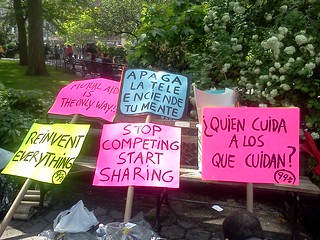
The sun came out over Madison Square Park as the OWS Free University
kicked off. Forgive the pun, but the class war was definitely in
session. Professors and experts gathered groups around htem throughout
the benches and pathways of this park as midtowners walking by stopped
to look. There was a lesson on "horizontal pedagogy,"--or how to teach
without hierarchy--talks by noted leftist thinkers Chris Hedges and
Francis Fox Piven, a discussion about native/indigenous resistance and
another about gender constructs, and most pertinently, a student debt
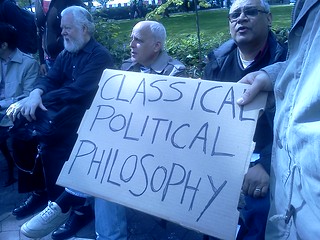
teach-in. One guy was even leading a class on "ancient political
philosophy" and I thought about the Athenian forum.
This action was meant to--and did--accomplish two goals. First, it
recaptured the "public square" aspect of Zuccotti Park occupation and
other encampments, that sense of people radically coming together and
talking to each other about major, transformative ideas without
boundaries or rules. Secondly, it demonstrated by example a principle of
communal, free, shared and sharing education without tuition or fees, a
rejoinder to the rising tuition costs at institutions across the
country.
As the "class" sessions came to an end under the sunshine,
demonstrators talked in clusters, took pictures and gathered around the
park's central fountain. And then the sound of chants, whistles, and
guitars began to float over the park.
Protesters rushed over to Broadway to see the advancing "guitarmy"
march--a musical, un-permitted, wild walk down from Bryant Park led by
Tom Morello, its members spilling out onto the sidewalks and the center
of Broadway flanked by the NYPD. Cheers and the sound of musical
instruments ensued as the march continued on its way down towards the
afternoon's destination: Union Square.
Global Justice
-- Alex Kane
The hundreds upon hundreds of protesters streaming into Union Square
on May Day were greeted by an elaborate paper “maypole.” There was no
need for explanation, as the top of the “maypole” read, “All our
grievances are connected”—another way of saying “We are the 99%.”
Walk a couple hundred feet in the park, and there's an Occupy Wall
Street group that fervently believes that maxim: the Occupy Wall Street
(OWS) Global Justice Working Group. A contingent of about 30 people
affiliated with the working group had gathered before the union-heavy
permitted march from Union Square to Wall Street. The reason? To
“declare our commitment to resist and to end wars at home and abroad,”
in the working group’s own words.
The names Iran, Palestine, Egypt and more were written on the
activists' placards. They joined thousands of demonstrators for a march
that capped off a day full of actions highlighting economic inequality,
police brutality, immigrant rights and more. In the streets, NY-based
Palestine solidarity activist Dave Lippman provided the guitar strumming
while others sang songs. “When you shop and when you dine,” they sang,
“stand up for Palestine”—a plea for boycotts of Israeli products.
Activists from the Global Justice Working Group are full of knowledge
and experience about struggles from Bahrain to Egypt to Palestine. It
includes organizers involved with Code Pink, the War Resisters League,
Adalah-NY and more--key groups that work on peace and justice issues in
the city. And they want to bring their knowledge to the broader world of
Occupy Wall Street activism. The march, and songs about struggles here
and abroad, were one way of doing that.
“Very often in OWS you get people who don’t know what’s going on
across the water,” explained Udi Pladott, an activist and former soldier
in the Israeli army. “We’re trying to inject global issues into
Occupy.” Towards that goal, the working group has sponsored events on
Bahrain and held a teach-in on the global tear-gas industry.
“We want to make connections between the war on the poor here and
wars abroad,” said Nancy Kricorian, an organizer with Code Pink.
Conversations with working group participants made clear what those
connections are: a system that rewards militarism with profits while
demanding austerity for the poor.
Apart from Bahrain and Palestine, the specter of a war with Iran, and
organizing to stop that possibility, was very much on the minds of OWS
Global Justice Working Group participants. A number of signs at the
march read “No to sanctions. No to war. No to state repression.” I spoke
with Manijeh Nasrabadi, a PhD student at New York University and an
organizer with Havaar, an Iranian group that now works with the Global
Justice Working Group, for more on this subject.
“There are people in Iran organizing against the same things. They
have a government pushing neoliberal policies,” she explained. Nasrabadi
also criticized the tendency of some on the left to reflexively back
Iran’s leaders since they are in opposition to the West, even as the
regime violently cracked down on dissent. “There is a third way: global
solidarity,” that isn’t morally compromised, Nasrabadi said.
I then asked Nasrabadi what the connection was between Iran, the US and the Occupy movement. Answers abound to that question.
But she had a simple answer that helps explain the importance of the
Global Justice Working Group: “If bombs fall, it would derail thinking
about class.”
Tom Morello and the Guitarmy/Union Square/
-- Julianne Escobedo Shepherd
Under unexpectedly sunny skies, thousands converged upon Union
Square yesterday afternoon, their numbers growing as the Tom
Morello-led “Guitarmy,” flanked by their acoustic axes, marched in from
Bryant Park. One of the only spots with a city permit, the Square was
the destination for the day’s live music, but it also served as a
safe space for those protesters unwilling or unable to risk arrest.
As such: the undocumented faction came out in droves, and it became a
symbolic place where unions and Occupy joined forces with immigrant’s
rights movements. People carried signs reading, “Amnesty Para Todos,”
“Trabajando y Educación Para Todos,” “Stop the Raids” and,
most crucially, “No a la guerra, ni a la militarización de la
frontera.” It’s important not to forget the bigger picture: the border
debates are an extension of our country’s war-obsession, and solve
no problems.
But the overall spirit at Union Square was one of joy and
enthusiasm and united strength. A large stage was set up to accommodate
the performers and speakers and the message was clear: through
art, activism can glean both power and relief. At around 4 PM, the
show started with the beloved Tom Morello, aka the Nightwatchman,
aka guitarist in Rage Against the Machine (which we recently learned is Paul Ryan’s favorite band, and who we hope will act on the knowledge by writing a song about him).
Because of the abundance of artists and speakers on the line-up, each
act only got to perform two songs, and Morello used his time most
effectively. Playing after a speaker announced, “We’re here to announce
that another world is not only possible, but on her way,” Morello
brought his around 20-person Guitarmy onstage to a fired-up crowd ready
to party for justice. He kicked off his set with a singalong of his song
“World Wide Rebel Songs,” which pays homage to union classics, and got
thousands of protesters singing the chorus (and freaking out when he
played the harmonica, because the proles, apparently, love a harmonica).
Then he noted that, were Woody Guthrie alive, he’d be 100, and that
if he were still with us, he’d be headlining the event. Morello’s next
song? “This Land is Your Land,” which resulted in another joyous
singalong and pogo session. His parting words: “Take it easy, but take
it.” Morello’s performance was followed by a speech by Emily Park, who
announced herself as an undocumented student at CUNY. “DREAMers like me
are the future of later,” she said, and advocated the New York DREAM Act
that’s currently underway at the state level. Then Joyce Lyon, of the
Domestic Workers union, reminded us that, “The thousands of you standing
here are the engines that make the economy run,” whether documented or
not.
Their speech was followed by a performance by an awesome
multinational Latin jazz band representing Local 802, the musician’s
union, during which the drummer protested the elimination of 31
multicultural categories at the Grammys. (Including the award for best
Latin jazz album and best Native American album, among others.) The band
was followed by performances by rap trio Das Racist (full disclosure:
the group is this reporter’s family), noise-pop musician Dan Deacon, and
rapper Immortal Technique, all of whom celebrated the energy and
presence of the thousands in the crowd. And while the focus was
certainly on the arts, the most salient point of the rally was made by a
speaker later in the day, who reminded us that the Supreme Court is on
the cusp of legalizing Arizona’s immigration law, SB 1070, and that it
was up to us to stand against similar racist laws like it. “This is not
an immigration issue,” she said. “This is a people issue.” The crowd was
penned in by barricades, guarded by ever-more police as the protest
geared up to march downtown, but her message was more powerful than the
city’s ominous message. Immigration is a people issue, and this was a
joyous, inspiring peoples’ protest.
Marching from Union Square After the Rally: 5:30 pm
-- Sarah Seltzer
Artists for Occupy and immigrant rights groups kicked off the long
march from Union Square to Wall Street down Broadway. Despite the
barricades and unnecessarily huge numbers of cops on both sides of the
street, marchers headed downtown undaunted. Among their numbers were
groups like the Teamsters, the Transit Workers Union, and student and
community organizations.
Groups let out chants like "we are students, not statistics!" the
very May Day-appropriate "black, Latin, Asian, white! Workers of the
world unite!" As we entered the shopping district they playfully shouted
"out of the shops, and into the streets!" But there was a more mellow
feeling than at marches past. One woman cheering for the protesters
pointed up at the newly-blue sky and grinned as if to say, "see? even
the weather's on your side!" Marchers ran into friends, hugged each
other and chatted. The solidarity all the unions and their official
signage showed for immigrants was remarkable--groups that once seemed to
have been divided by the one percent were making a huge effort to stand
up for each other. And the atmosphere was one of festive righteous
anger: one protester walked by a Jesus costume carrying a massive cross,
and another in a Captain American costume waved at us to applause from a
window above.
As the very vanguard of the march, led by taxicabs festooned in
banners, crossed Houston Street a huge cry went up and echoed back,
turning Broadway into a canyon of noise for block after block after
block.
"This is some serious shit," an onlooker said, shaking his head with a
smile, at the throngs weaving back all the way to Union Square.
Occupied Lower Manhattan, evening
--Sarah Jaffe
The financial district was occupied all evening--occupied by the
NYPD, who were out in riot gear, brandishing batons, lining up on side
streets and marching two by two down to rallying points for tired but
fired-up occupiers from the final march.
As the march--with crowd estimates of 30,000 or so--wound down,
hundreds or even thousands wound up in the space at 55 Water Street,
where they held a People's Assembly as night fell. The crowd was
peaceful, but the space closed at 10 and so of course the NYPD moved in,
calling for dispersal and threatening arrests. City Councilmembers
Ydanis Rodriguez and Jumaane Williams were on hand with several members
of the clergy, observing and gathering evidence. The two councilmembers
are part of a lawsuit filed this week against the NYPD.
I followed a breakout march up side streets, and while at first it
was disorganized, a crew of experienced Occupiers, including many from
the Plus Brigades (a newer working group that specifically works on
clowning and other positive reactions in order to defuse tense
situations with police) took lead of the march, walking arm in arm,
dancing, and singing. The tension faded from the air as they marched,
for a while, without police interference, singing "This is what
democracy looks like."
When we came to Wall Street, though, we ran into a barricade--it
seems that the worst thing Occupiers can do is attempt to set foot on
the actual street their movement is named for. The march turned up
William and then down Pine, and as the crew paused to debate where to go
next, reports of police violence down on Pearl Street--where we'd just
been--came in over Twitter from reporters John and Molly Knefel and Ryan
Devereaux. We sat on the steps of a JP Morgan Chase building on Pine,
and as some discussed tactics and plans for the rest of the night,
stragglers came up William, visibly shaken by what they'd seen. "Police
were just grabbing people, throwing them to the ground," one marcher
said.
And then the police arrived, bearing batons and riot cuffs. They
cleared the steps mostly without incident, though as has come to be
usual there was tension and a faceoff for a while before most of the
crowd dispersed back down Pine--where a line of police reinforced a line
of barricades once again, keeping the crowd from getting anywhere near
Wall Street.
Many of the Occupiers wound up where Occupy began, back in Zuccotti
Park, where only one side was barricaded off and about 100 people were
sitting, chatting in small groups, discussing, once again, what would
come next--for the evening, for the movement, for everyone involved. A
week of action is planned for later in May, and Brooklyn College is
holding a rally today, May 2nd, to build on momentum from May Day.
Oakland/Bay Area:
-- Joshua Holland
The Bay Area celebrated May Day with a series of strikes and protests
throughout the day, as 19 local labor unions joined thousands of
Occupiers and immigrant rights activists.
The Inlandboatmen's Union staged a half-day strike, shutting down
ferry service from Sausalito to San Francisco. The ferry workers are in a
dispute with management over health-care costs, and have been working
without a contract for over a year. Early in the morning, they were
joined by Occupy protesters in a picket line at the Larkspur Ferry
Terminal. Bus and bridge workers had promised to honor the picket.
About 200 people participated in a peaceful but boisterous
immigrants' rights march in San Francisco's Mission District in the
morning. Several separate demonstrations wound their way through
downtown Oakland, trailed by a heavy police presence. At one point, tear
gas was deployed to disperse a crowd, according to protesters who were
on the scene.
In the afternoon, a large contingent of Occupy San Francisco
activists -- as many as 1,500 -- marched from the Financial District to
set up residence in a vacant building from which they had been evicted
weeks earlier. The building, formerly a shelter, is owned by the
Archdiocese of San Francisco.
Police staged around the corner during the afternoon, but at around
4:30, approximately 200 officers clad in riot gear moved in, erecting
barricades around the building. A tense standoff ensued, during which
time a man on the roof of the building threw several objects -- a brick
and some metal pipes -- at police, striking and injuring another
protester, who was taken away by ambulance. A San Francisco police
spokesman later said that the man had been apprehended and charged with
aggravated assault.
After several hours facing down protesters, police again pulled back,
and as of press time, protesters had flooded back into the building en
masse.
The largest action of the day took place in Oakland during the
evening, as an estimated 3,000 people took to the streets around City
Hall. The protest was largely uneventful until after nightfall when, in a
scene that has come to be all-too-familiar, Oakland police ended up
dispersing occupiers with tear gas and "flash-bang" grenades. As of
press time, arrests were ongoing.
Sarah Jaffe is an associate editor at AlterNet, a rabblerouser and frequent Twitterer. You can follow her at @seasonothebitch.Sarah
Seltzer is an associate editor at AlterNet and a freelance writer based
in New York City. Her work has been published at the Nation, the
Christian Science Monitor, Jezebel and the Washington Post. Follow her
on Twitter at @fellowette and find her work at sarahmseltzer.com. Julianne
Escobedo Shepherd is an associate editor at AlterNet and a
Brooklyn-based freelance writer and editor. Formerly the executive
editor of The FADER, her work has appeared in VIBE, SPIN, New York Times
and various other magazines and websites. Alex Kane is AlterNet's New York-based World editor, and a staff reporter for Mondoweiss. Follow him on Twitter @alexbkane. Joshua Holland is an editor and senior writer at AlterNet. He is the author of The
15 Biggest Lies About the Economy: And Everything else the Right
Doesn't Want You to Know About Taxes, Jobs and Corporate America. Drop him an email or follow him on Twitter.
NYC's Mayor Michael Bloomberg found a new demographic to force his food regulations on, the homeless. Hasn't it gone a little too far when we are trying to monitor the sodium intake of the people who live their lives on the streets, never knowing where their next meal is coming from? Apparently Bloomberg doesn't think that it is too far, new regulations in New York ban the donation of food to homeless shelters.
"Too Crooked to Fail": Matt Taibbi Says Bailouts, Fraud are the Secrets to Bank of America’s Success
In his new article, "Bank of America: Too Crooked to Fail," Rolling Stone reporter Matt Taibbi chronicles the remarkable history of the rise of Bank of America, an institution he says has defrauded "everyone from investors and insurers to homeowners and the unemployed." Taibbi describes how the Bush and Obama administrations have repeatedly propped up the financial institution, which received a $45 billion taxpayer bailout in 2008. Bank of America has also received billions in what could be described as shadow bailouts. The bank now owns more than 12 percent of the nation’s bank deposits and 17 percent of all home mortgages. Taibbi also recounts how fraudulent practices by Bank of America and other companies ravaged pension funds. "Most people think of [the mortgage crisis] as some airy abstraction — you know, bankers ripping off bankers," Taibbi says. "That’s not what it is. It’s bankers stealing from old ladies and retirees." [original includes rush transcript]
Guest:
Matt Taibbi, contributing editor for Rolling Stone. He is the author of five books, most recently, Griftopia: Bubble Machines, Vampire Squids, and the Long Con That Is Breaking America. His latest article in Rolling Stone is titled "Bank of America: Too Crooked to Fail."
Matt Taibbi on the Explosive Resignation of Goldman Sachs Executive Greg Smith
Financial reporter Matt Taibbi talks about Goldman Sach’s history of denigrating its own clients, as recently highlighted by former Goldman executive Greg Smith’s explosive resignation letter in the New York Times. Decrying what he called Goldman’s "toxic" culture, Smith said bosses at the firm called their clients "muppets" and strove to maximize profits at the expense of client interests, adding: "It makes me ill how callously people talk about ripping their clients off." Goldman Sachs is now reportedly scanning internal emails for the term "muppet" and other evidence that employees referred to clients in derogatory ways. "This gives ... people in the industry, institutional investors, tremendous pause: why would I want to do business with this company if this is their attitude towards me?" says Taibbi. "They’re thinking how much can they get out of me, and not how much money they can make for me." [original includes rush transcript]
Guest:
Matt Taibbi, contributing editor for Rolling Stone. He is the author of five books, most recently, Griftopia: Bubble Machines, Vampire Squids, and the Long Con That Is Breaking America. His latest article in Rolling Stone is titled "Bank of America: Too Crooked to Fail."
Police Arrest 73 in Occupy Wall Street Crackdown as Protesters Mark Six Months Since Uprising Began
Michael Moore led hundreds of people from the Left Forum conference to Zuccotti Park on Saturday where hundreds had gathered to reoccupy the park to mark six months since the launch of the Occupy Wall Street movement, which began last September and launched protests around the world that gave voice to "the 99 percent." That night, New York City police officers cleared the park, making at least 73 arrests. Many people reported excessive use of force by officers; several cases were caught on camera. In one widely reported incident, a young woman suffered a seizure after she was pulled from the crowd and arrested. Witnesses say police initially ignored Cecily McMillan as she flopped about on the sidewalk with her hands zip-tied behind her back, but she was eventually taken away in an ambulance. For more, we talk to Guardian reporter Ryan Devereaux, who has been following the Occupy movement closely. [Original includes rush transcript]
Guest:
Ryan Devereaux, a journalist for The Guardian and a former Democracy Now! fellow who has been reporting on Occupy Wall Street
MARCH 19, 2012 .
Strategic Directions for Occupy Wall Street: Foreclosing Banks, Defending Homes, Making History
Famed sociologist Frances Fox Piven and labor organizer Stephen Lerner discuss how Occupy Wall Street could grow into a major political movement that draws millions into the streets. "I’m absolutely convinced that Occupy is the beginning of another massive protest movement," Fox Piven says. "Protest movements have a long life—10, 15 years—and they are what we have to rely on to take our country back." Fox Piven is professor of political science and sociology at The Graduate Center, City University of New York, and author of "Challenging Authority: How Ordinary People Change America." Lerner is a labor organizer who was the architect of the Justice for Janitors campaign and is on the executive board of the Service Employees International Union. He has been working with labor and community groups nationally on how to hold Wall Street accountable. "I think there’s never been a more exciting time in my 30 years of organizing to imagine building the kind of movement that can transform the country, that can really talk about redistributing wealth and power. And there’s never a better time to get involved," Lerner says. We are also joined by Guardian reporter Ryan Devereaux, who has been reporting on Occupy Wall Street extensively. [Original includes rush transcript]
Guests:
Frances Fox Piven, author and professor of political science and sociology at The Graduate Center, City University of New York. Her latest book is Who’s Afraid of Frances Fox Piven?: The Essential Writings of the Professor Glenn Beck Loves to Hate, as well as Challenging Authority: How Ordinary People Change America.
Stephen Lerner, the architect of the Justice for Janitors campaign. He is on the executive board of the Service Employees International Union and works with labor and community groups nationally on how to hold Wall Street accountable.
Ryan Devereaux, a journalist for The Guardian and a former Democracy Now! fellow who has been reporting on Occupy Wall Street.
Richest 1 Percent Account For Nearly All Of U.S. Recovery's Gains: Report
The Huffington Post Alexander Eichler
First Posted: 03/ 5/2012 11:31 am Updated: 03/ 5/2012 5:44 pm
Technically, the economy has been in recovery for two years. But it turns out the rich have been doing most of the recovering.
In 2010 -- the first full year since the end of the Great Recession -- virtually all of the income growth in America took place among the country's very wealthiest people, says an economist at the University of California, Berkeley. The top 1 percent of earners took in a full 93 percent of all the income gains that year, leaving the other 7 percent of gains to be sprinkled among the vast majority of society.
Those numbers come courtesy of Emmanuel Saez, the Berkeley economist who co-created a resource known as the World Top Incomes Database. Saez and his colleagues crunched the data on income growth from 2010, the most recent year available, and found that it was shockingly lopsided.
While much of the country is simply treading water, with a growing number of people either edging toward poverty or already there, the richest of the rich seem to be coping nicely.
Saez's findings suggest that even though the recession dealt a blow to the 1 percent, it did little to push the U.S. off the path it's been on for decades -- that of a vast and growing disparity between the richest and poorest citizens.
Income for most workers has barely risen in the last 30 years, but the top 1 percent of earners have seen their income almost triple in the same amount of time. Economists and other experts say that could be the result of any number of factors, including the decline of labor unions, the explosion in capital gains during the middle part of the aughts, and tax policies put in place in recent years that favor the wealthy.
In his State of the Union address this past January, President Obama called economic fairness "the defining issue of our time," perhaps mindful of the growing number of voters who say they can't even afford basic necessities like food.
The wealth gap has been cited as a major concern for the nationwide Occupy movement, and research has suggested that income inequality might be associated with the kind of underwhelming economic growth the country has experienced for the past two years.
Occupy the SEC: Former Wall Street Workers Defend Volcker Rule Against Banks’ Anti-Regulatory Push
The latest offshoot of the Occupy Wall Street movement, Occupy the SEC, has submitted a 325-page comment to the Securities and Exchange Commission that calls on regulators to resist the financial industry’s lobbying efforts to water down the Volcker Rule, a section in the Dodd–Frank Wall Street Reform and Consumer Protection Act, that aims to prevent large banks from making certain kinds of risky, speculative investments. The group is made up of former Wall Street professionals who once worked at many of the largest financial firms in the industry. We’re joined by Alexis Goldstein, who worked as a computer programmer for seven years at Morgan Stanley, Merrill Lynch and Deutsche Bank. She left Wall Street in 2010 and joined the Occupy Wall Street movement soon after the encampment began. "Banks shouldn’t behave like a hedge fund," Goldstein says. "Hedge funds are there to make money and take risky bets, and their clients tend to be these really wealthy clients. And the Volcker Rule sort of says, 'Well, wait a minute. These big banks that enjoy all this government support shouldn't be in that business." [Original includes rush transcript]
News From Underground is a daily e-news service run by Mark Crispin Miller, a Professor of Culture and Communication at NYU. It is based on his belief that academics, like reporters, have a civic obligation to help keep the people well-informed, so that American democracy might finally work.
Wednesday, December 28, 2011
Occupy Rigged Elections: A Call for the Second American Revolution in 2012
When candidates emerge who support the positions and demands of the 99 percent, the more certain we can be that our elections will be rigged.
A protester with the Occupy movement is
led away by law enforcement after interrupting
New Jersey Gov. Chris Christie at a campaign
event for former Massachusetts Governor
Mitt Romney.
(Photo: Eric Thayer / The New York Times)
A great battle is coming. The 2012 elections are our chance to turn the tide back toward real democracy, but we must begin immediately. Only by organizing for a democratic revolution now can we break the hold of corporate criminals over our elections and take real power in 2012, legitimately and nonviolently.
Thanks to Occupy Wall Street and the 99 percent movement, millions of Americans are finally shaking off the depression and torpor of the past decade, heeding the mass-consciousness call to reclaim power from corporatist forces that have hijacked our country, our planet, and our future. We may not all have taken to the streets yet, but we will. Or we'll contribute in other creative, personally liberating ways, pitching in with prison-break fervor to unblock the channels of revolutionary energy.
Despite the jeering of the corporate media, the Occupy movement is not going to fade away, burn out or be crushed like the radical movements of the 60s and 70s. The Occupy movement is going to change the world, because the world itself has arrived at a momentous crossroads where change is inevitable. Occupy is part of an unstoppable transformation - the contractions of a new world desperate to be born, based on a renewal of community, tolerance, justice and deep respect for all life. A sane, resilient world capable of withstanding the ecological, climatic and economic upheavals we can no longer avoid.
Now is the time to prepare, in this newly awakened, prerevolutionary phase, for Occupy Elections 2012. Because the closer we get to democratically taking power - when candidates emerge who support the positions and demands of the 99 percent - the more certain we can be that our elections will be rigged.
Anarchists and many younger activists today reject representative democracy as unviable. They are rightly disgusted with the macabre, corporate-sponsored, electoral charade we endure every two years like a recurring nightmare. The Occupy movement has already birthed a powerful new form of roots-down direct democracy, where learning to communicate and really hearing each other is the first step toward rebuilding our shattered and alienated communities.
So, do elections matter anymore? Is representative democracy for the People even possible?
Wherever you are on the revolutionary road, whoever you are in your mind and soul, we ask you to please listen to the message we're conveying today, and consider how it impacts your activism in the coming year.
American elections are not going away any time soon. They are rigged, and we must end the rigging - for the sake of our planet and its 7 billion people, entwined in complex technological and social systems that do require some form of representative government to function.
Our electoral process is rigged in the following ways:
Manipulation of electoral structures and mechanisms
Partisan redistricting, which re-draws electoral district maps that favor a particular party.
Voter ID laws that disenfranchise young, poor and minority voters.
Fraudulent purging of voter rolls, including "caging" - removing a voter from the rolls or discarding their vote based on the return of direct mail to their listed address, a practice found to be used fraudulently and with racial bias, making it illegal under the Voting Rights Act.
Disenfranchisement of felons, many poor, black or Hispanic, and convicted on drug offenses.
The battle to topple the corporatocracy must strategically attack all of these points. But for the purpose of this call to action - Occupy Rigged Elections - we're going to focus on the last, least understood bullet point: computerized election fraud.
In the end, how ballots are counted - the central control mechanism of democracy - could prove the easiest piece to reclaim; our first real step toward radically shifting power back toward the people.
Computerized Vote Rigging Is a Democratic Cancer
Undiagnosed, spreading through our nation's bones, centralized election rigging has been undermining the health of our democracy for decades, eating away at it from within, leaving us exhausted and hopeless - though unsure of why we're so sick.
But let's get something clear up front: not every election is rigged, so don't be confused by the few decent people who managed to get into office and stay there. First, ask yourself this question: Have they stopped the corporatist takeover? The answer is no.
Pay attention to the balance of power; watch it tipping ever further toward the corporatist/fascist side of the scale. Meanwhile, the spectacle of democracy maintains a pacified public. In other words, they will let some of "our" people in, or let some of our initiatives pass, while they keep winning more power, overall. Additionally - not all elections are easy to rig, and some have far higher stakes. But there is one constant in the equation:
Every election can be rigged. Undetectably.
If this is news to you, hang on to your hat. Once you understand how the machinery of the American voting system actually works, you're going to feel a little stunned, as if you came home from a three month vacation to discover you left your keys hanging in the front door.
Over the past 40 years - since computers first came online for use in processing and reporting votes - our secretaries of state and election supervisors have literally sold our democratic system to a small criminal cadre of extreme right-wing and religious ideologues who lurk behind shady voting machine companies. The top three are Diebold (purchased by ES&S in 2009), ES&S, and Sequoia Pacific (purchased by Dominion). They manufactured the majority of voting machines and software that secretly count our ballots.
Read it again. Let it sink in.
Yes, it's insane. For this reason alone, we have every reason to have lost faith in electoral democracy, but as you can see, we need to understand why it is failing. We need to know whose big, fat, dirty thumb is on the scale. We need to know how we lost our power before we can hope to reclaim it.
Hand-Counted Paper Ballots NOW!
This is the organic solution. Properly designed, cast in see-through plastic boxes, counted by hand, in public, on election day, with a stringent set of safeguards and a vigilant public - paper ballots can deliver fast results and provide a fully transparent and accountable voting system. Attempted fraud can be detected and prevented. Conversely, computerized election theft is accomplished secretly, within the "proprietary" software owned by the corporations who manufacture the machines.
Did you know that no one - not even an election supervisor - is allowed to view the software?
We know these things because a small group of American election integrity activists have been working tirelessly, without much recognition or compensation, to compile a mountain of evidence:
Detailing the criminal histories and the partisan and extremist ties of the voting machine manufacturers
Demonstrating how the machines can be rigged and hacked
Exposing Department of Justice (DOJ) coverups of election fraud evidence
Exposing the roll of the corporate media in aiding and abetting election fraud
See the resource list at the end of this article to learn more. Get informed. Take action, and please help us fight back – WE NEED YOU.
Democracy is our birthright, but it has never been fully realized. We've had to fight and die for the right to fight and die for it. It's a dream, a shared vision, a work in progress that has been derailed. Though some activists idealize earlier times - pre-industrial, communal, tribal - we can't go backwards, only forward. What do we want today? Tomorrow? What do we want for ourselves and our children?
We want our damn democracy back.
We want the chance to make it real for the first time, with our own candidates who truly represent the needs of the people, and with a safe voting system accountable to the people.
Help us organize to secure hand-counted paper ballots before the 2012 elections. This is something we can do, if we start now. The stakes of those elections could not be higher.
Victoria Collier is the daughter and niece of James and Kenneth Collier, authors of the book "Votescam: The Stealing of America." She is the editor of www.votescam.org.
Ronnie Cummins
Ronnie Cummins is the national director of the Organic Consumers Association, campaigning on behalf of its 1 million members for food safety, public health and corporate accountability.
Forget monetary policy. Re-examining the cause of the Great Depression—the revolution in agriculture that threw millions out of work—the author argues that the U.S. is now facing and must manage a similar shift in the “real” economy, from industry to service, or risk a tragic replay of 80 years ago.
t has now been almost five years since the bursting of the housing bubble, and four years since the onset of the recession. There are 6.6 million fewer jobs in the United States than there were four years ago. Some 23 million Americans who would like to work full-time cannot get a job. Almost half of those who are unemployed have been unemployed long-term. Wages are falling—the real income of a typical American household is now below the level it was in 1997.
DOMINO THEORY The financial meltdown
is the Depression parallel everyone notices.
The more frightening parallel is everything else.
We knew the crisis was serious back in 2008. And we thought we knew who the “bad guys” were—the nation’s big banks, which through cynical lending and reckless gambling had brought the U.S. to the brink of ruin. The Bush and Obama administrations justified a bailout on the grounds that only if the banks were handed money without limit—and without conditions—could the economy recover. We did this not because we loved the banks but because (we were told) we couldn’t do without the lending that they made possible. Many, especially in the financial sector, argued that strong, resolute, and generous action to save not just the banks but the bankers, their shareholders, and their creditors would return the economy to where it had been before the crisis. In the meantime, a short-term stimulus, moderate in size, would suffice to tide the economy over until the banks could be restored to health.
The banks got their bailout. Some of the money went to bonuses. Little of it went to lending. And the economy didn’t really recover—output is barely greater than it was before the crisis, and the job situation is bleak. The diagnosis of our condition and the prescription that followed from it were incorrect. First, it was wrong to think that the bankers would mend their ways—that they would start to lend, if only they were treated nicely enough. We were told, in effect: “Don’t put conditions on the banks to require them to restructure the mortgages or to behave more honestly in their foreclosures. Don’t force them to use the money to lend. Such conditions will upset our delicate markets.” In the end, bank managers looked out for themselves and did what they are accustomed to doing.
Even when we fully repair the banking system, we’ll still be in deep trouble—because we were already in deep trouble. That seeming golden age of 2007 was far from a paradise. Yes, America had many things about which it could be proud. Companies in the information-technology field were at the leading edge of a revolution. But incomes for most working Americans still hadn’t returned to their levels prior to the previous recession. The American standard of living was sustained only by rising debt—debt so large that the U.S. savings rate had dropped to near zero. And “zero” doesn’t really tell the story. Because the rich have always been able to save a significant percentage of their income, putting them in the positive column, an average rate of close to zero means that everyone else must be in negative numbers. (Here’s the reality: in the years leading up to the recession, according to research done by my Columbia University colleague Bruce Greenwald, the bottom 80 percent of the American population had been spending around 110 percent of its income.) What made this level of indebtedness possible was the housing bubble, which Alan Greenspan and then Ben Bernanke, chairmen of the Federal Reserve Board, helped to engineer through low interest rates and nonregulation—not even using the regulatory tools they had. As we now know, this enabled banks to lend and households to borrow on the basis of assets whose value was determined in part by mass delusion.
The fact is the economy in the years before the current crisis was fundamentally weak, with the bubble, and the unsustainable consumption to which it gave rise, acting as life support. Without these, unemployment would have been high. It was absurd to think that fixing the banking system could by itself restore the economy to health. Bringing the economy back to “where it was” does nothing to address the underlying problems.
The trauma we’re experiencing right now resembles the trauma we experienced 80 years ago, during the Great Depression, and it has been brought on by an analogous set of circumstances. Then, as now, we faced a breakdown of the banking system. But then, as now, the breakdown of the banking system was in part a consequence of deeper problems. Even if we correctly respond to the trauma—the failures of the financial sector—it will take a decade or more to achieve full recovery. Under the best of conditions, we will endure a Long Slump. If we respond incorrectly, as we have been, the Long Slump will last even longer, and the parallel with the Depression will take on a tragic new dimension.
Until now, the Depression was the last time in American history that unemployment exceeded 8 percent four years after the onset of recession. And never in the last 60 years has economic output been barely greater, four years after a recession, than it was before the recession started. The percentage of the civilian population at work has fallen by twice as much as in any post-World War II downturn. Not surprisingly, economists have begun to reflect on the similarities and differences between our Long Slump and the Great Depression. Extracting the right lessons is not easy.
any have argued that the Depression was caused primarily by excessive tightening of the money supply on the part of the Federal Reserve Board. Ben Bernanke, a scholar of the Depression, has stated publicly that this was the lesson he took away, and the reason he opened the monetary spigots. He opened them very wide. Beginning in 2008, the balance sheet of the Fed doubled and then rose to three times its earlier level. Today it is $2.8 trillion. While the Fed, by doing this, may have succeeded in saving the banks, it didn’t succeed in saving the economy.
Reality has not only discredited the Fed but also raised questions about one of the conventional interpretations of the origins of the Depression. The argument has been made that the Fed caused the Depression by tightening money, and if only the Fed back then had increased the money supply—in other words, had done what the Fed has done today—a full-blown Depression would likely have been averted. In economics, it’s difficult to test hypotheses with controlled experiments of the kind the hard sciences can conduct. But the inability of the monetary expansion to counteract this current recession should forever lay to rest the idea that monetary policy was the prime culprit in the 1930s. The problem today, as it was then, is something else. The problem today is the so-called real economy. It’s a problem rooted in the kinds of jobs we have, the kind we need, and the kind we’re losing, and rooted as well in the kind of workers we want and the kind we don’t know what to do with. The real economy has been in a state of wrenching transition for decades, and its dislocations have never been squarely faced. A crisis of the real economy lies behind the Long Slump, just as it lay behind the Great Depression.
For the past several years, Bruce Greenwald and I have been engaged in research on an alternative theory of the Depression—and an alternative analysis of what is ailing the economy today. This explanation sees the financial crisis of the 1930s as a consequence not so much of a financial implosion but of the economy’s underlying weakness. The breakdown of the banking system didn’t culminate until 1933, long after the Depression began and long after unemployment had started to soar. By 1931 unemployment was already around 16 percent, and it reached 23 percent in 1932. Shantytown “Hoovervilles” were springing up everywhere. The underlying cause was a structural change in the real economy: the widespread decline in agricultural prices and incomes, caused by what is ordinarily a “good thing”—greater productivity.
t the beginning of the Depression, more than a fifth of all Americans worked on farms. Between 1929 and 1932, these people saw their incomes cut by somewhere between one-third and two-thirds, compounding problems that farmers had faced for years. Agriculture had been a victim of its own success. In 1900, it took a large portion of the U.S. population to produce enough food for the country as a whole. Then came a revolution in agriculture that would gain pace throughout the century—better seeds, better fertilizer, better farming practices, along with widespread mechanization. Today, 2 percent of Americans produce more food than we can consume.
What this transition meant, however, is that jobs and livelihoods on the farm were being destroyed. Because of accelerating productivity, output was increasing faster than demand, and prices fell sharply. It was this, more than anything else, that led to rapidly declining incomes. Farmers then (like workers now) borrowed heavily to sustain living standards and production. Because neither the farmers nor their bankers anticipated the steepness of the price declines, a credit crunch quickly ensued. Farmers simply couldn’t pay back what they owed. The financial sector was swept into the vortex of declining farm incomes.
The cities weren’t spared—far from it. As rural incomes fell, farmers had less and less money to buy goods produced in factories. Manufacturers had to lay off workers, which further diminished demand for agricultural produce, driving down prices even more. Before long, this vicious circle affected the entire national economy.
The value of assets (such as homes) often declines when incomes do. Farmers got trapped in their declining sector and in their depressed locales. Diminished income and wealth made migration to the cities more difficult; high urban unemployment made migration less attractive. Throughout the 1930s, in spite of the massive drop in farm income, there was little overall out-migration. Meanwhile, the farmers continued to produce, sometimes working even harder to make up for lower prices. Individually, that made sense; collectively, it didn’t, as any increased output kept forcing prices down.
Given the magnitude of the decline in farm income, it’s no wonder that the New Deal itself could not bring the country out of crisis. The programs were too small, and many were soon abandoned. By 1937, F.D.R., giving way to the deficit hawks, had cut back on stimulus efforts—a disastrous error. Meanwhile, hard-pressed states and localities were being forced to let employees go, just as they are now. The banking crisis undoubtedly compounded all these problems, and extended and deepened the downturn. But any analysis of financial disruption has to begin with what started off the chain reaction.
The Agriculture Adjustment Act, F.D.R.’s farm program, which was designed to raise prices by cutting back on production, may have eased the situation somewhat, at the margins. But it was not until government spending soared in preparation for global war that America started to emerge from the Depression. It is important to grasp this simple truth: it was government spending—a Keynesian stimulus, not any correction of monetary policy or any revival of the banking system—that brought about recovery. The long-run prospects for the economy would, of course, have been even better if more of the money had been spent on investments in education, technology, and infrastructure rather than munitions, but even so, the strong public spending more than offset the weaknesses in private spending.
Government spending unintentionally solved the economy’s underlying problem: it completed a necessary structural transformation, moving America, and especially the South, decisively from agriculture to manufacturing. Americans tend to be allergic to terms like “industrial policy,” but that’s what war spending was—a policy that permanently changed the nature of the economy. Massive job creation in the urban sector—in manufacturing—succeeded in moving people out of farming. The supply of food and the demand for it came into balance again: farm prices started to rise. The new migrants to the cities got training in urban life and factory skills, and after the war the G.I. Bill ensured that returning veterans would be equipped to thrive in a modern industrial society. Meanwhile, the vast pool of labor trapped on farms had all but disappeared. The process had been long and very painful, but the source of economic distress was gone.
he parallels between the story of the origin of the Great Depression and that of our Long Slump are strong. Back then we were moving from agriculture to manufacturing. Today we are moving from manufacturing to a service economy. The decline in manufacturing jobs has been dramatic—from about a third of the workforce 60 years ago to less than a tenth of it today. The pace has quickened markedly during the past decade. There are two reasons for the decline. One is greater productivity—the same dynamic that revolutionized agriculture and forced a majority of American farmers to look for work elsewhere. The other is globalization, which has sent millions of jobs overseas, to low-wage countries or those that have been investing more in infrastructure or technology. (As Greenwald has pointed out, most of the job loss in the 1990s was related to productivity increases, not to globalization.) Whatever the specific cause, the inevitable result is precisely the same as it was 80 years ago: a decline in income and jobs. The millions of jobless former factory workers once employed in cities such as Youngstown and Birmingham and Gary and Detroit are the modern-day equivalent of the Depression’s doomed farmers.
The consequences for consumer spending, and for the fundamental health of the economy—not to mention the appalling human cost—are obvious, though we were able to ignore them for a while. For a time, the bubbles in the housing and lending markets concealed the problem by creating artificial demand, which in turn created jobs in the financial sector and in construction and elsewhere. The bubble even made workers forget that their incomes were declining. They savored the possibility of wealth beyond their dreams, as the value of their houses soared and the value of their pensions, invested in the stock market, seemed to be doing likewise. But the jobs were temporary, fueled on vapor.
Mainstream macro-economists argue that the true bogeyman in a downturn is not falling wages but rigid wages—if only wages were more flexible (that is, lower), downturns would correct themselves! But this wasn’t true during the Depression, and it isn’t true now. On the contrary, lower wages and incomes would simply reduce demand, weakening the economy further.
Of four major service sectors—finance, real estate, health, and education—the first two were bloated before the current crisis set in. The other two, health and education, have traditionally received heavy government support. But government austerity at every level—that is, the slashing of budgets in the face of recession—has hit education especially hard, just as it has decimated the government sector as a whole. Nearly 700,000 state- and local-government jobs have disappeared during the past four years, mirroring what happened in the Depression. As in 1937, deficit hawks today call for balanced budgets and more and more cutbacks. Instead of pushing forward a structural transition that is inevitable—instead of investing in the right kinds of human capital, technology, and infrastructure, which will eventually pull us where we need to be—the government is holding back. Current strategies can have only one outcome: they will ensure that the Long Slump will be longer and deeper than it ever needed to be.
wo conclusions can be drawn from this brief history. The first is that the economy will not bounce back on its own, at least not in a time frame that matters to ordinary people. Yes, all those foreclosed homes will eventually find someone to live in them, or be torn down. Prices will at some point stabilize and even start to rise. Americans will also adjust to a lower standard of living—not just living within their means but living beneath their means as they struggle to pay off a mountain of debt. But the damage will be enormous. America’s conception of itself as a land of opportunity is already badly eroded. Unemployed young people are alienated. It will be harder and harder to get some large proportion of them onto a productive track. They will be scarred for life by what is happening today. Drive through the industrial river valleys of the Midwest or the small towns of the Plains or the factory hubs of the South, and you will see a picture of irreversible decay.
Monetary policy is not going to help us out of this mess. Ben Bernanke has, belatedly, admitted as much. The Fed played an important role in creating the current conditions—by encouraging the bubble that led to unsustainable consumption—but there is now little it can do to mitigate the consequences. I can understand that its members may feel some degree of guilt. But anyone who believes that monetary policy is going to resuscitate the economy will be sorely disappointed. That idea is a distraction, and a dangerous one.
What we need to do instead is embark on a massive investment program—as we did, virtually by accident, 80 years ago—that will increase our productivity for years to come, and will also increase employment now. This public investment, and the resultant restoration in G.D.P., increases the returns to private investment. Public investments could be directed at improving the quality of life and real productivity—unlike the private-sector investments in financial innovations, which turned out to be more akin to financial weapons of mass destruction.
Can we actually bring ourselves to do this, in the absence of mobilization for global war? Maybe not. The good news (in a sense) is that the United States has under-invested in infrastructure, technology, and education for decades, so the return on additional investment is high, while the cost of capital is at an unprecedented low. If we borrow today to finance high-return investments, our debt-to-G.D.P. ratio—the usual measure of debt sustainability—will be markedly improved. If we simultaneously increased taxes—for instance, on the top 1 percent of all households, measured by income—our debt sustainability would be improved even more.
The private sector by itself won’t, and can’t, undertake structural transformation of the magnitude needed—even if the Fed were to keep interest rates at zero for years to come. The only way it will happen is through a government stimulus designed not to preserve the old economy but to focus instead on creating a new one. We have to transition out of manufacturing and into services that people want—into productive activities that increase living standards, not those that increase risk and inequality. To that end, there are many high-return investments we can make. Education is a crucial one—a highly educated population is a fundamental driver of economic growth. Support is needed for basic research. Government investment in earlier decades—for instance, to develop the Internet and biotechnology—helped fuel economic growth. Without investment in basic research, what will fuel the next spurt of innovation? Meanwhile, the states could certainly use federal help in closing budget shortfalls. Long-term economic growth at our current rates of resource consumption is impossible, so funding research, skilled technicians, and initiatives for cleaner and more efficient energy production will not only help us out of the recession but also build a robust economy for decades. Finally, our decaying infrastructure, from roads and railroads to levees and power plants, is a prime target for profitable investment.
The second conclusion is this: If we expect to maintain any semblance of “normality,” we must fix the financial system. As noted, the implosion of the financial sector may not have been the underlying cause of our current crisis—but it has made it worse, and it’s an obstacle to long-term recovery. Small and medium-size companies, especially new ones, are disproportionately the source of job creation in any economy, and they have been especially hard-hit. What’s needed is to get banks out of the dangerous business of speculating and back into the boring business of lending. But we have not fixed the financial system. Rather, we have poured money into the banks, without restrictions, without conditions, and without a vision of the kind of banking system we want and need. We have, in a phrase, confused ends with means. A banking system is supposed to serve society, not the other way around.
That we should tolerate such a confusion of ends and means says something deeply disturbing about where our economy and our society have been heading. Americans in general are coming to understand what has happened. Protesters around the country, galvanized by the Occupy Wall Street movement, already know.