Showing posts with label Statistics. Show all posts

Monday, November 17, 2014

In the wake of the mid-term election two weeks ago, the despicable "mainstream media" have been busy "explaining" that the reason consistant pre-polling showing Democrats running neck-and-neck with their Republican adversarys or clearly winning yet losing on election day by 4 or 5 percentage points was due to errors made by the pollsters. Anyone who knows anything about statistics knows that random errors should be in both directions. Here election integrity advocate Brad Freeman responds to one such stolen-election-cover-up artist, Nate Silver. Note the vast amount of data Brad cites in making the case that there was massive fraud in this election, all favoring Republican candidates.


The Results Were Skewed Toward Republicans: A Response to Nate Silver

By BRAD FRIEDMAN on 11/7/2014, 6:02am PT 


It's been happening for years now. On the day after elections like last Tuesday's, media figures begin navel gazing to figure out how pre-election polls, created by dozens of independent pollsters using dozens of different methodologies, could all find the same thing but turn out to be so wrong once the election results are in.

The presumption is that the results are always right, and if they don't match the pre-election polling, its the polling that must be wrong, as opposed to the election results.

On Wednesday morning, after Tuesday's mid-term election surprise in which Republicans reportedly won handily in race after race despite pre-election polls almost unanimously predicting much closer races or outright Democratic victories, FiveThirtyEight statistics guru Nate Silver declared "The Polls Were Skewed Toward Democrats".

His analysis of aggregated averages from dozens of different pollsters and polls this year found that the performance of Democrats was overestimated by approximately 4 percentage points in Senate races and 3.4 points in gubernatorial contests. Silver's assessment relies on a "simple average of all polls released in the final three weeks of the campaign," as compared to the (unofficial and almost entirely unverified) election results reported on Tuesday night. He doesn't suggest there was anything nefarious in the polling bias towards Dems this year, simply that the pollsters got it wrong for a number of speculative reasons.

Citing the fact that nearly all of the polls suggested Democrats would do much better than they ultimately did, when compared to the reported election results, Silver asserts it wasn't that the polls were more wrong that usual, per se, but that almost all of them were wrong in a way that appears to have overestimated Democratic performance on Election Day.

"This year's polls were not especially inaccurate," he explains. "Between gubernatorial and Senate races, the average poll missed the final result by an average of about 5 percentage points --- well in line with the recent average. The problem is that almost all of the misses were in the same direction."

Silver is much smarter than I when it comes to numbers; I'm happy to presume he has the basic math right. But he seems to have a blind spot in his presumption that the pre-election polls were wrong and the election results were right. That, despite the lack of verification of virtually any of the results from Tuesday night, despite myriad and widespread if almost completely ignored problems and failures at polls across the country that day, and despite systematic voter suppression and dirty tricks that almost certainly resulted in election results (verified or otherwise) that were skewed toward Republicans...

No doubt you're familiar by now with many of the surprising results Silver cites --- he describes them as "missed 'calls'" and "errors". For example, he notes, pollsters erred in the governor's races "including in Illinois and Kansas and especially in Maryland, where Republican Larry Hogan wound up winning by 9 percentage points despite trailing in every nonpartisan poll released all year."

In Senate contests, he wrote earlier on Wednesday, "Some of the worst misses came in states like Kentucky and Arkansas where the Republican won, but by a considerably larger margin than polls projected. There was also a near-disaster in Virginia. It looks like Democratic incumbent Mark Warner will pull out the race, but the polls had him up by 9 points rather than being headed for a photo finish."

There are many more examples you likely know by now. There were similar surprises in some ballot measures and down-ticket races as well. For example, in Kansas, controversial Republican Sec. of State Kris Kobach was reportedly "tied" with his Democratic challenger last week, according to KSN-TV's SurveyUSA poll. Yet, according to the results on Kobach's own KS Secretary of State site, he "won" the election by a remarkable 18 points. (That's a single poll, not an average of many, but you get the idea.)

Those results, as well as the ones cited by Silver, could, in fact, be correct. The trouble is a) we don't know, because nobody bothers to verify the computer-reported results (even in states which use paper ballots systems that could be verified, unlike states that use touch-screen systems) and b) they ignore all of the problems with voting systems and the ability of voters to even access them in the first place.

While many Americans may be familiar with the surprise of Tuesday's reported results, not nearly as many are aware of the problems that plagued voters across the country. So, here, for those who aren't regular BRAD BLOG readers, are just a few examples of those problems where not all, but most, seemed to skew the election and its results away from Democratic voters and towards the GOP:

• Polling place Photo ID and other voter ID voting restrictions have been shown, over and over again, in study after study and court case after court case, to adversely and disproportionately disadvantage Democratic-leaning voters. Wendy Weiser of NYU Law School's Brennan Center for Justice released a report on Wednesday, asking "how much of a difference did new voting restrictions", making it "harder to vote in 21 states" this year, have on the reported outcome of the elections?

Weiser rounds up up summaries of data in four states suggesting that "in several key races, the margin of victory came very close to the likely margin of disenfranchisement."

In the Kansas gubernatorial race, Weiser explains, Gov. Sam Brownback (R) beat challenger Paul Davis (D) by "less than 33,000 votes". That, despite a strict Photo ID law "put into effect right before the 2012 election, and a new documentary proof of citizenship requirement for voter registration," implemented by Sec. of State Kobach. "We know from the Kansas secretary of state that more than 24,000 Kansans tried to register this year but their registrations were held in 'suspense' because they failed to present the documentary proof of citizenship now required by state law."

Silver cites the pre-election polling average in the state that gave the Democrat Davis a 2.8 point advantage over Brownback in the days leading up to the election. Brownback reportedly won the race on Tuesday --- Silver calls it the "Actual Result" --- by 3.8 points, a 6.6 swing between pre-election polls and election results.

How many voters couldn't vote because they were blocked due to Kobach's scheme to disallow voters who didn't turn in some sort of "proof" of citizenship, even though they'd registered to vote with the national voter registration form that says nothing about a need to supply such documents?

Weiser goes on to cite the Senate race in Virginia, where Democratic U.S. Senator Mark Warner, who had been pegged by pre-election polls to win by 8.5 points, beat Republican challenger Ed Gillespie by just .6, or "just over 12,000 votes". That, despite the state's new Photo ID law, enacted last year, which, according to the Virginia Board of Elections, means that "198,000 'active Virginia voters' did not have acceptable ID this year." Moreover, as Silver himself estimated when he worked for the New York Times (he now works for ESPN), such restrictive voting laws reduce turnout by about 2.4%, meaning, according to Weiser, "a reduction in turnout by more than 52,000 voters" in Virginia.

In Alabama, on the Friday before the election, the state Attorney General quietly issued an edict that Public Housing IDs would no longer be allowable for use in voting there under that state's Photo ID voting law. How many lost their right to vote on Tuesday?

In Arkansas, though the state's Photo ID restriction was struck down by the state Supreme Court after being found a violation of the state's constitution, poll workers were reportedly asking voters for Photo ID anyway, leading the Arkansas Times to declare there were "voter suppression reports from all over" on Election Day and a "steady stream of complaints...from voters who say election officials around Arkansas demanded a photo ID before they could vote today."

In that state, pre-election polls predicted that Democratic Sen. Mark Pryor was likely to lose to Republican Tom Cotton by 4.7 points. The results show him as having lost by 17.

In Texas, reportedly, "the number of provisional ballots cast more than doubled since the last mid-term election in 2010." That, after the U.S. Supreme Court allowed a strict polling place Photo ID law to be implemented this year, and despite a U.S. District Court finding, after a full trial, that the GOP law was "purposefully discriminatory", an "unconstitutional poll tax" and could disenfranchise as many as 600,000 disproportionately minority and poor registered voters.

The Government Accountability Office (GAO) found in a study earlier this year that polling place Photo ID restrictions in Kansas and Tennessee had decreased voter turnout in those states by 2 to 3% after they were enacted in 2012, and at even higher rates for minority and young voters.

While we'll have to wait to learn more about the specific effect of Photo ID restrictions on voters this year --- and we'll never know how many didn't even bother to show up, knowing that they lacked the specific type of Photo ID now needed to vote --- is it too early to consider how all of that voter suppression affect the reported election results this year in TX, AR, AL, KS and VA? More or less than the "Democratic bias" Silver finds in almost all of the pre-election polling averages?

• The Electronic Voter ID system went down for still unknown reasons in Florida in the Democratic stronghold of Broward County, resulting in voters who were unable to vote on Election Day. Gov. Rick Scott (R) is said to have defeated former Gov. Charlie Crist (D) there by just over 1%. Moreover, as Weiser notes, a host of new voting restrictions enacted by Florida Republicans over the last several years, included "a decision by Scott and his clemency board to make it virtually impossible for the more than 1.3 million Floridians who were formerly convicted of crimes but have done their time and paid their debt to society to have their voting rights restored." Might any of that had an adverse effect on the Democrats' results in the Sunshine State Tuesday night, an effect that wasn't picked up on in pre-election polls?

• Mysterious robocalls over the weekend before the election resulted in 2,000 election judges failing to show up for work at all in Illinois' Democratic stronghold of Chicago on Tuesday morning. The failure of one-fifth of the city's judges to show up resulted in many polls being short-handed during the morning rush or unable to open at all. Might that have affected the reported results in the Illinois Governor's race where the incumbent Democrat Pat Quinn was expected to win by .3, according to Silver's aggregated poll averages, but ended up losing instead by almost 5 points?

• Touchscreen votes were reported as flipping Democratic to Republican in Texas, Tennessee, Pennsylvania, Virginia and elsewhere, including in North Carolina where 100% unverifiable touch-screen votes reportedly flipped from incumbent Sen. Kay Hagan (D) to her challenger Thom Tillis (R). She was predicted to win by a small margin in the pre-election poll average --- and even, reportedly, according to Election Day exit polls late in the day --- but she ended up reportedly losing by almost 2 points or about 48,000 votes.

North Carolina voters also faced the most extreme voter suppression law since the Jim Crow era this year. Hundreds of voters are known to have been disenfranchised during the much smaller turnout during the state's primary election in April. As Weiser reports, during "the last midterms in 2010, 200,000 voters cast ballots during the early voting days now cut" by the new Republican law, a huge number of them were minority voters who tend to vote Democratic. Moreover, same-day registration for voters was nixed this year by the same law. Additionally, she writes, "7,500 voters cast their ballots outside of their home precincts" in 2012, but this year, the U.S. Supreme Court allowed all of those provisions of the new GOP law to be implemented, even after the U.S. 4th Circuit Court of Appeals had struck them down, finding "that African-American voters disproportionately used those electoral mechanisms and that House Bill 589 restricted those mechanisms and thus disproportionately impacts African-American voters."

Might any of those issues have resulted a Republican skew in the election results, many of which are based on ballots cast that were cast and registered --- either correctly or incorrectly, we can never know --- on 100% unverifiable electronic voting systems?

(For the record, unverifiable touch-screen votes also reportedly flipped in either unknown directions or from Republicans to Democrats in Arkansas, Illinois, Virginia and Maryland. Though reports of D to R flips are historically much more common, they also flip from R to D as well on occasion, a factor not accounted for at all in pre-election polling or in Silver's analysis of results.)

• Registration issues plagued voters in a number of states. I've already mentioned the thousands of Kansas voters unable to vote in state elections this year, but what of those 50,000 voter registrations in Georgia collected during a progressive registration drive there? It's alleged they were never entered into the system by the state's Republican Sec. of State. Might that have had an impact on the perceived "Democratic bias" in the polls compared to the results collected on the state's 100% unverifiable touch-screen voting system in the race for Georgia's open U.S. Senate seat between Democrat Michelle Nunn and Republican David Perdue? In that contest, the pre-election poll average projected a 6.4% better result for the Democrat than the one ultimately reported by the computer tabulators.

In New Mexico and in Louisiana, where there were important races for Governor and the U.S. Senate respectively, the GOP-controlled states are accused of undermining voter registration by failing to properly implement National Voter Registration Act requirements to offer voter registration opportunities to residents via social services outlets, such as those applying for drivers licenses or medicaid or food stamps.

Across the nation, as Greg Palast reported at Al-Jazeera last week, millions of voters were threatened with disenfranchisement in some 20 states, thanks to an "Interstate Crosscheck" database created by Kansas' Kobach with a number of other GOP-run states. The database, while secretly implemented, is supposed to check for possible multiple registrations by voters in those states. Palast reports, however, that the system is plagued with errors, disproportionately targets minority voters, and might have resulted in unknown numbers of voters inappropriately removed from the voting rolls entirely and/or challenged at the polls on Election Day.

• Not enough paper ballots left voters unable to vote verifiably in Ferguson, MO and elsewhere in St. Louis County, as well as the city of St. Louis. The jurisdictions scrambled to print and deliver new ballots throughout the day, but many voters were effected, particularly during the morning rush and late in the day, when lines grew long and polls had to stay open to accommodate those who could afford to wait. At one polling place in Florissant, a town just adjacent to Ferguson, a poll supervisor reported that when they opened the polling place in the morning "they only had five of one of the paper ballots when they typically need about 300 of that version."

Could the difficulty voters had casting a vote in the predominantly African-American areas of St. Louis served to skew final results in favor of Republicans there?

We could go on. And on. And on. And on. There were many more problems across the country, and undoubtedly others yet to come to light, but you get the idea. And, of course, none of that takes into account whether any of the reported results themselves were accurately tabulated by the oft-failed computer systems which tabulate almost all our nation's ballots.

How much impact did all of those factors --- and more we haven't mentioned and more still rolling in --- have on the results? We don't yet know. But to simply presume the independent pre-election polls by dozens of different pollsters, each using their own unique methodology, were all simply wrong (skewed towards Democrats) seems presumptuous at best, at this hour, and recklessly misleading from someone like Silver (whose work, I should add, I generally admire).

Perhaps a question that he might better be able to help us all answer is: "What are the statistical odds of so many races all skewing towards the GOP?"

Am I suggesting that elections were stolen by the Republicans? There is no doubt it was a good year for Republicans. But there is also no doubt that it was GOP voter suppression laws that affected turnout and the ability of many voters to be able to cast their votes at all, so that could certainly have swung a number of contests. On the other hand, stealing that many elections wholesale in that many states via electronic voting systems, without leaving evidence behind --- particularly on our nation's hodge-podge of different types of systems --- would be a very difficult feat, most likely requiring a very large conspiracy. In such cases, it's usually difficult to keep such a large conspiracy quiet. There are a few ways it could be done with a somewhat smaller conspiracy of insiders, but we'll leave that discussion for another day.

Whether races would have had a different winner is ultimately unknown, but all of the items mentioned above could have had an effect on the polling averages versus the reported election results.

While Silver's focus on polling and reported results is understandable, the analysis he offered is itself a skewed picture of what actually happened on Tuesday. It presumes that election results reported on our terrible electronic voting and tabulation systems, amidst voter suppression efforts unprecedented since the Jim Crow era, are accurate, while it was the pollsters who must have got it all wrong --- and wrong, by a remarkable coincidence, in a way that supposedly overestimated Democratic turnout in almost every case.

While an analysis of such numbers is interesting media bait --- particularly for those to whom elections are little more than a horse race, rather than an exercise of the fundamental right which supposedly protects all others in this nation --- it offers Americans a skewed and misleading story. It suggests, without any evidence to support such a broad assumption, that the results were "right" and the pollsters were "wrong."

That may be an easy to story to tell, but it just isn't an accurate or helpful one. It serves only to skew our nation and our media even further from a once-great representative democracy to little more than a biennial ESPN Sports Center extravaganza.

* * *
Please help support The BRAD BLOG's fiercely independent, award-winning coverage of your electoral system --- now in our ELEVENTH YEAR! --- as available from no other media outlet in the nation...

Thursday, June 14, 2012

U.S. ELECTIONS ARE RECORDED ON HACKABLE ELECTRONIC VOTING MACHINES AND RECORDED BY PRIVATE CONTRACTORS, WHILE THE CORPORATE-OWNED "MAINSTREAM" MEDIA MAKE UP STORIES TO EXPLAIN UNEXPECTED OUTCOMES ...EVEN THOUGH THESE OUTCOMES ARE "STATICALLY IMPOSSIBLE" IN AN UNRIGGED ELECTION.


Bob Fitrakis

Wisconsin: None dare call it vote rigging
June 14, 2012

If vote-rigging prospers, none may call it vote-rigging. It simply becomes the new norm. Once again, the universal laws of statistics apply only outside U.S. borders. The recall vote in Wisconsin produced another significant 7% discrepancy between the unadjusted exit poll and the so-called "recorded vote." In actual social science, this level of discrepancy, with the results being so far outside the expected margin of error would not be accepted.

When I took Ph.D. statistics to secure my doctorate in political science, we were taught to work through the rubric, sometime referred to as HISMISTER. The "H" stood for an explanation of the discrepancy rooted in some historical intervention, such as one of the candidates being caught in a public restroom with his pants down and a "wide stance" soliciting an undercover cop. The "I" that came next suggested we should check our instrumentation, that is, are the devices adequately reporting the data?

Here's where U.S. elections become laughable. A couple of private companies, count our votes with secret proprietary hardware and software, the most notable being ES&S. Every standard of election transparency is routinely violated in the U.S. electronic version of faith-based voting. How the corporate-dominated media deals with the issue is by "adjusting the exit polls." They simply assume the recorded vote on easily hacked and programmed private machines are correct and that the international gold standard for detecting election fraud – exit polls – must be wrong.

They are not going to go through the rest of the acronym and check to see if the Sample makes sense, that the right Measurements are being taken, or whether or not there's been a breakdown in Implementing the exit polling. They won't check to see if the representative Size of the polling numbers are accurate, or if there are problems with the pollster's Technique, or if there was human Error, or if there's just bad Recording going on.

Of course, the machines could be recording wrong because they are programmed for an incorrect outcome. The easiest people to convince regarding the absurdity of electronic voting with private proprietary hardware and software are the computer programmers across the political spectrum. Statisticians and mathematicians also readily comprehend the obvious nature of rigged elections.

One of my favorite mathematicians is Richard Charnin, who on his website using readily available public information, calculates the odds of the so-called ‘red shift" occurring from the 1988 to 2008 presidential elections. The red shift refers to the overwhelming pick up of votes by the Republican Party in recorded votes over what actual voters report to exit pollsters.

In Charnin's analysis of exit poll data, we can say with a 95% confidence level – that means in 95 out of 100 elections – that the exit polls will fall within a statistically predictable margin of error. Charnin looked at 300 presidential state exit polls from 1988 to 2008, 15 state elections would be expected to fall outside the margin of error. Shockingly, 137 of the 300 state presidential exit polls fell outside the margin of error.

What is the probability of this happening?

"One in one million trillion trillion trlllion trillion trillion trillion," said Charnin.

More proof of Republican operatives and sympathizers is found in the fact that 132 of the elections fell outside the margin in favor of the GOP. We would expect eight.

Say you have a fair coin to flip. We would expect that if we flip that coin there would be an even split between heads and tails – or in this case, Republicans and Democrats. Election results falling outside the margin of error should be equally split between both parties. Yet, only five times, less than expected, did the extra votes fall in the direction of the Democratic Party.

So what are the odds? According to Charnin, of 132 out of 300 state presidential elections exceeding the margin of error in the direction of the Republicans – one in 600 trillion trillion trillion trillion trillion trillion trillion trillion trillion.

The corporate-owned media does not want to mention that the problems with the exit polls began with the ascendancy of the former CIA Director George Herbert Walker Bush to the presidency in 1988. It is also that year when the non-transparent push-and-pray voting machines were introduced in the New Hampshire primary by Bush ally John Sununu. Bush, who rigged elections for the CIA throughout the Third World did unexpectedly well where the voting machines were brought in.

In any other election outside the U.S., the U.S. State Department would condemn the use of the these highly riggable machines based on the discrepancy in the exit polls. It's predictable what would happen if an anti-U.S. KGB agent in some former Soviet Central Asian republic picked up an unexplained 5% of the votes at odds with the exit polls. A new election would be called for, as it was in the Ukraine in 2004. We would not have accepted the reported vote from the corrupt intelligence officer.

The CIA Director's son wins with laughable exit poll discrepancies in 2000 and 2004 and the mainstream media sees no evil. The media's perspective is to discredit the exit polls, which they sponsor, and call any who point to the polls "conspiracy theorists."

In 2004, 22 states had a red shift to the CIA Director's son, George W. Bush. Usually such improbably results are signs of a Banana Republic. Now we have a too-close-to-call neck and neck recall race in Wisconsin that show an obvious red shift for a right-wing red governor. Nobody wants to look at the non-transparent black box machines. Electronic election rigging has prospered. Long live the "adjusted" vote totals.

--
Originally published by The Free Press, http://freepress.org.


Wednesday, March 14, 2012

THE LATEST ASSESSMENT OF THE TOP INCOMES IN THE U.S.: THE RICH ARE GETTING RICHER AND THE POOR ARE SCREWED


Blogger's Note:  The graph above was derived from earlier work by Emmanuel Saez (the author of the article below) and Thomas Piketty. It was not part of the new work by Saez presented below, which was taken from a pdf file available here.  Four footnotes to the present article appeared originally at the bottoms of the pages where they were first cited but are here placed in square brackets and moved to the end, together with the author's coordinates.  Conversely, the figures found at the end of the original version are here moved to where they are first mentioned in the text.


Striking it Richer:
The Evolution of Top Incomes in the United States
(Updated with 2009 and 2010 estimates)


Emmanuel Saez•

March 2, 2012

What’s new for recent years?

Great Recession 2007-2009
         During the Great Recession, from 2007 to 2009, average real income per family declined dramatically by 17.4% (Table 1),[1] the largest two year drop since the Great Depression. Average real income for the top percentile fell even faster (36.3 percent decline, Table 1), which lead to a decrease in the top percentile income share from 23.5 to 18.1 percent (Figure 2). Average real income for the bottom 99% also fell sharply by 11.6%, also by far the largest two year decline since the Great Depression. This drop of 11.6% more than erases the 6.8% income gain from 2002 to 2007 for the bottom 99%.


Computations based on family market income including realized capital gains (before individual taxes).
Incomes exclude government transfers (such as unemployment insurance and social security) and non-taxable fringe benefits.
Incomes are deflated using the Consumer Price Index.
Column (4) reports the fraction of total real family income growth (or loss) captured by the top 1%.
For example, from 2002 to 2007, average real family incomes grew by 16.1% but 65% of that growth
accrued to the top 1% while only 35% of that growth accrued to the bottom 99% of US families.
From 2009 to 2010, average real family incomes increased by 2.3% and the top 1% captured 93% of those gains.
Source: Piketty and Saez (2003), series updated to 2010 in March 2012 using IRS tax statistics.
          The sharp fall in top incomes is explained primarily by the collapse of realized capital gains due to the stock-market crash. Aggregate realized capital gains fell from $895 billion in 2007 to $236 billion in 2009. Indeed, including realized capital gains, the top decile income share dropped from 49.7% in 2007 to 46.5% in 2009 while excluding realized capital gains, the top decile income share remained virtually constant from 45.7% in 2007 to 45.5% in 2009 (Figure 1).
         The fall in top decile income share from 2007 to 2009 is actually less than during the 2001 recession from 2000 to 2002, in part because the Great recession has hit bottom 90% incomes much harder than the 2001 recession (Table 1), and in part because upper incomes excluding realized capital gains have resisted relatively well during the Great Recession. The top 1% absorbed 49% of income losses from 2007 to 2009 while they absorbed a bigger 57% share of the income losses from 2000 to 2002.


FIGURE 1
The Top Decile Income Share, 1917-2010
Source: Table A1 and Table A3, col. P90-100.
Income is defined as market income (and excludes government transfers).
In 2010, top decile includes all families with annual income above $108,000.
2010: Recovering from the Great Recession 
          In 2010, average real income per family grew by 2.3% (Table 1) but the gains were very uneven. Top 1% incomes grew by 11.6% while bottom 99% incomes grew only by 0.2%. Hence, the top 1% captured 93% of the income gains in the first year of recovery. Such an uneven recovery can help explain the recent public demonstrations against inequality. It is likely that this uneven recovery has continued in 2011 as the stock market has continued to recover. National Accounts statistics show that corporate profits and dividends distributed have grown strongly in 2011 while wage and salary accruals have only grown only modestly. Unemployment and non-employment have remained high in 2011.
          This suggests that the Great Recession will only depress top income shares temporarily and will not undo any of the dramatic increase in top income shares that has taken place since the 1970s. Indeed, excluding realized capital gains, the top decile share in 2010 is equal to 46.3%, higher than in 2007 (Figure 1).
          Looking further ahead, based on the US historical record, falls in income concentration due to economic downturns are temporary unless drastic regulation and tax policy changes are implemented and prevent income concentration from bouncing back. Such policy changes took place after the Great Depression during the New Deal and permanently reduced income concentration until the 1970s (Figures 2, 3). In contrast, recent downturns, such as the 2001 recession, lead to only very temporary drops in income concentration (Figures 2, 3).


FIGURE 2
Decomposing the Top Decile US Income Share into 3 Groups, 1913-2010
Source: Table A3, cols. P90-95, P95-99, P99-100.
Income is defined as market income including capital gains.
Top 1% denotes the top percentile (families with annual income above $352,000 in 2010)
Top 5-1% denotes the next 4% (families with annual income between $150,000 and $352,000 in 2010)
Top 10-5% denotes the next 5% (bottom half of the top decile, families with annual income
between $108,000 and $150,000 in 2010).


FIGURE 3
The Top 0.01% Income Share, 1913-2010
Source: Table A1 and Table A3, col. P99.99-100.
Income is defined as market income including (or excluding) capital gains.
In 2010, top .01% includes the 15,617 top families with annual income above $7,890,000.
Getting income distribution data faster

          Timely distributional statistics are central to enlighten the public policy debate. This is particularly true at this time of great public interest in inequality. Distributional statistics used to estimate our series are produced by the Statistics of Income Division of the Internal Revenue Service (http://www.irs.gov/taxstats/). Those statistics are extremely high quality and final, but come with an almost 2-year lag.
          The Statistics of Income, in partnership with academic researchers, is developing methods to produce preliminary distributional statistics significantly earlier. The goal is to use tax return data processed in real time by the IRS to project distributions for the complete year. Preliminary investigations show that it is possible to obtain reliable statistics about one year in advance of the final statistics.

Text of “Striking it Richer” updated with 2010 estimates

          The recent dramatic rise in income inequality in the United States is well documented. But we know less about which groups are winners and which are losers, or how this may have changed over time. Is most of the income growth being captured by an extremely small income elite? Or is a
broader upper middle class profiting? And are capitalists or salaried managers and professionals the main winners? I explore these questions with a uniquely long-term historical view that allows me to place current developments in deeper context than is typically the case.
          Efforts at analyzing long-term trends are often hampered by a lack of good data. In the United States, and most other countries, household income surveys virtually did not exist prior to 1960. The only data source consistently available on a long-run basis is tax data. The U.S. government has published detailed statistics on income reported for tax purposes since 1913, when the modern federal income tax started. These statistics report the number of taxpayers and their total income and tax liability for a large number of income brackets. Combining these data with population census data and aggregate income sources, one can estimate the share of total personal income accruing to various upper-income groups, such as the top 10 percent or top 1 percent.
          We define income as the sum of all income components reported on tax returns (wages and salaries, pensions received, profits from businesses, capital income such as dividends, interest, or rents, and realized capital gains) before individual income taxes. We exclude government transfers such as Social Security retirement benefits or unemployment compensation benefits from our income definition. Non-taxable fringe benefits such as employer provided health insurance is also excluded from our income definition. Therefore, our income measure is defined as cash market income before individual income taxes.
          Evidence on U.S. top income shares Figure 1 presents the income share of the top decile from 1917 to 2010 in the United States. In 2010, the top decile includes all families with market income above $108,000. The overall pattern of the top decile share over the century is U-shaped. The share of the top decile is around 45 percent from the mid-1920s to 1940. It declines substantially to just above 32.5 percent in four years during World War II and stays fairly stable around 33 percent until the 1970s. Such an abrupt decline, concentrated exactly during the war years, cannot easily be reconciled with slow technological changes and suggests instead that the shock of the war played a key and lasting role in shaping income concentration in the United States. After decades of stability in the post-war period, the top decile share has increased dramatically over the last twenty-five years and has now regained its pre-war level. Indeed, the top decile share in 2007 is equal to 49.7 percent, a level higher than any other year since 1917 and even surpasses 1928, the peak of stock market bubble in the “roaring” 1920s. In 2010, the top decile share is equal to 47.9 percent.
          Figure 2 decomposes the top decile into the top percentile (families with income above $352,000 in 2010) and the next 4 percent (families with income between $150,000 and $352,000 in 2010), and the bottom half of the top decile (families with income between $108,000 and $150,000 in 2010). Interestingly, most of the fluctuations of the top decile are due to fluctuations within the top percentile. The drop in the next two groups during World War II is far less dramatic, and they recover from the WWII shock relatively quickly. Finally, their shares do not increase much during the recent decades. In contrast, the top percentile has gone through enormous fluctuations along the course of the twentieth century, from about 18 percent before WWI, to a peak to almost 24 percent in the late 1920s, to only about 9 percent during the 1960s-1970s, and back to almost 23.5 percent by 2007. Those at the very top of the income distribution therefore play a central role in the evolution of U.S. inequality over the course of the twentieth century. The implications of these fluctuations at the very top can also be seen when we examine trends in real income growth per family between the top 1 percent and the bottom 99 percent in recent years as illustrated on Table 1. From 1993 to 2010, for example, average real incomes per family grew by only 13.8% over this 17 year period (implying an annual growth rate of .76%).  However, if one excludes the top 1 percent, average real incomes of the bottom 99% grew only by 6.4% from 1993 to 2010 (implying an annual growth rate of .37%). Top 1 percent incomes grew by 58% from 1993 to 2010 (implying a 2.7% annual growth rate). This implies that top 1 percent incomes captured slightly more than half of the overall economic growth of real incomes per family over the period 1993-2010.
          The 1993–2010 period encompasses, however, a dramatic shift in how the bottom 99 percent of the income distribution fared. Table 1 next distinguishes between five sub-periods: (1) the 1993–2000 expansion of the Clinton administrations, (2) the 2000-2002 recession, (3) the 2002-2007 expansion of the Bush administrations, (4) the 2007-2009 Great Recession, (5) and 2009-2010, the first year of recovery. During both expansions, the incomes of the top 1 percent grew extremely quickly by 98.7% and 61.8% respectively. However, while the bottom 99 percent of incomes grew at a solid pace of 20.3% from 1993 to 2000, these incomes grew only 6.8% percent from 2002 to 2007. As a result, in the economic expansion of 2002-2007, the top 1 percent captured two thirds of income growth. Those results may help explain the disconnect between the economic experiences of the public and the solid macroeconomic growth posted by the U.S. economy from 2002 to 2007. Those results may also help explain why the dramatic growth in top incomes during the Clinton administration did not generate much public outcry while there has been a great level of attention to top incomes in the press and in the public debate since 2005.
          During both recessions, the top 1 percent incomes fell sharply, by 30.8% from 2000 to 2002, and by 36.3% from 2007 to 2009. The primary driver of the fall in top incomes during those recessions is the stock market crash which reduces dramatically realized capital gains, and, especially in the 2000-2002 period, the value of executive stock-options. However, bottom 99 percent incomes fell by 11.6% from 2007 to 2009 while they fell only by 6.5 percent from 2000 to 2002. Therefore, the top 1 percent absorbed a larger fraction of losses in the 2000-2002 recession (57%) than in the Great recession (49%). The 11.6 percent fall in bottom 99 percent incomes is the largest fall on record in any two year period since the Great Depression of 1929-1933.
          From 2009 to 2010, average real income per family grew by 2.3%(Table 1) but the gains were very uneven. Top 1% incomes grew by 11.6% while bottom 99% incomes grew only by 0.2%. Hence, the top 1% captured 93% of the income gains in the first year of recovery.[2] Such an uneven recovery can possibly explain the recent public demonstrations against inequality. The top percentile share declined during WWI, recovered during the 1920s boom, and declined again during the great depression and WWII. This very specific timing, together with the fact that very high incomes account for a disproportionate share of the total decline in inequality, strongly suggests that the shocks incurred by capital owners during 1914 to 1945 (depression and wars) played a key role.[3] Indeed, from 1913 and up to the 1970s, very top incomes were mostly composed of capital income (mostly dividend income) and to a smaller extent business income, the wage income share being very modest. Therefore, the large decline of top incomes observed during the 1914-1960 period is predominantly a capital income phenomenon. Interestingly, the income composition pattern at the very top has changed considerably over the century. The share of wage and salary income has increased sharply from the 1920s to the present, and especially since the 1970s. Therefore, a significant fraction of the surge in top incomes since 1970 is due to an explosion of top wages and salaries. Indeed, estimates based purely on wages and salaries show that the share of total wages and salaries earned by the top 1 percent wage income earners has jumped from 5.1 percent in 1970 to 12.4 percent in 2007.[4]
          Evidence based on the wealth distribution is consistent with those facts. Estimates of wealth concentration, measured by the share of total wealth accruing to top 1 percent wealth holders, constructed by Wojciech Kopczuk and myself from estate tax returns for the 1916-2000 period in the United States show a precipitous decline in the first part of the century with only fairly modest increases in recent decades. The evidence suggests that top incomes earners today are not “rentiers” deriving their incomes from past wealth but rather are “working rich,” highly paid employees or new entrepreneurs who have not yet accumulated fortunes comparable to those accumulated during the Gilded Age. Such a pattern might not last for very long. The drastic cuts of the federal tax on large estates could certainly accelerate the path toward the reconstitution of the great wealth concentration that existed in the U.S. economy before the Great Depression.
          The labor market has been creating much more inequality over the last thirty years, with the very top earners capturing a large fraction of macroeconomic productivity gains. A number of factors may help explain this increase in inequality, not only underlying technological changes but also the retreat of institutions developed during the New Deal and World War II - such as progressive tax policies, powerful unions, corporate provision of health and retirement benefits, and changing social norms regarding pay inequality. We need to decide as a society whether this increase in income inequality is efficient and acceptable and, if not, what mix of institutional and tax reforms should be developed to counter it.

_______________________________

• University of California, Department of Economics, 549 Evans Hall #3880, Berkeley, CA 94720. This is an updated version of “Striking It Richer: The Evolution of Top Incomes in the United States”, Pathways Magazine, Stanford Center for the Study of Poverty and Inequality, Winter 2008, 6-7. Much of the discussion in this note is based on previous work joint with
Thomas Piketty. All the series described here are available in excel format at http://elsa.berkeley.edu/~saez/TabFig2010.xls
 
[1] This decline is much larger than the real official GDP decline of 3.8% from 2007-2009 for several reasons. First, our income measure includes realized capital gains while realized capital gains are not included in GDP. Our average real income measure excluding capital gains decreased by 10.8% (instead of 17.4%). Second, the total number of US families increased by 2.5% from 2007 to 2009 mechanically reducing income growth per family relative to aggregate income growth. Third, nominal GDP decreased by 0.6% while the total market nominal income aggregate we use (when excluding realized capital gains) decreased by 5.5%. This discrepancy is due to several factors: (a) nominal GDP decreased only 0.6% while nominal National Income (conceptually closer to our measure) decreased by 2%. In net, income items included in National Income but excluded from our income measure grew over the 2007-2009 period. The main items are supplements to wages and salaries (mostly employer provided benefits), rental income of persons (which imputes rents for homeowners),
and undistributed profits of corporations (see National Income by Type of Income, Table 1.12,
http://www.bea.gov/national/nipaweb/SelectTable.asp).

[2] The exact percentage 93% is sensitive to measurement error, especially the growth in the total number of families from 2009 to 2010, estimated from the Current Population Survey. However, the conclusion that most of the gains from economic growth was captured by the top 1% is not in doubt.
 
[3] The negative effect of the wars on top incomes can be explained in part by the large tax increases enacted to finance the wars. During both wars, the corporate income tax was drastically increased and this reduced mechanically the distributions to stockholders.

[4] Interestingly, this dramatic increase in top wage incomes has not been mitigated by an increase in mobility at the top of the wage distribution. As Wojciech Kopczuk, myself, and Jae Song have shown in a separate paper, the probability of staying in the top 1 percent wage income group from one year to the next has remained remarkably stable since the 1970s.

Monday, February 06, 2012


The January Jobs Are Statistical Artifacts

February 6, 2012  | Original here

Last Friday the US Bureau of Labor Statistics reported that in the first month of this new year 243,000 jobs were created and the unemployment rate (U.3) fell to 8.3 percent. This good news is a mirage. It is due to faulty seasonal adjustments and to the BLS birth/death model. In a prolonged downturn, seasonal adjustments and the birth/death model produce nonexistent employment.

The unadjusted data show a rise in the unemployment rate. The birth/death model, which estimates the net effect of jobs lost from business failures and jobs created by new start-ups was designed for a normal growing economy, not for a prolonged downturn four years old. Statistician John Williams (shadowstats.com) reports that the BLS adds 48,000 new jobs per month to the payroll employment report based on the birth/death model even though the economy has not come out of the deep recession. In other words, over the course of a year, the birth/death model adds about 580,000 jobs to the reported jobs numbers. End of year benchmark revisions quietly take the nonexistent jobs out of the totals, but these revisions do not receive headlines and pass largely unnoticed.

The reported January jobs gains are contradicted by other official reports. For example, the January payroll jobs report shows 50,000 new jobs in manufacturing, but according to the recently released 4th quarter GDP, 81% of the reported growth consisted of undesired inventory accumulation. Normally, companies produce for sales not for inventories. Why would manufacturers be hiring people to produce goods for undesired inventories?

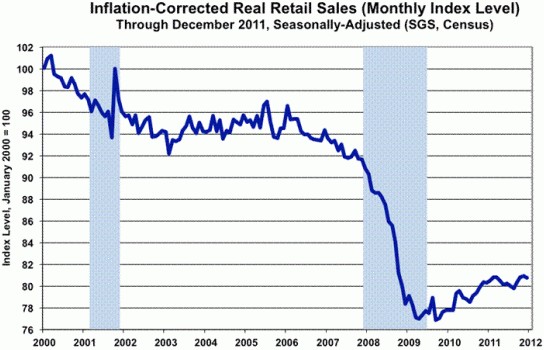
Most of the new reported January jobs are in services. The January jobs report has 24,500 new jobs in wholesale and retail trade and 13,100 in transportation and warehousing. However the data shows that inflation-corrected real retail sales are down. Why does it take more people to sell fewer goods?

The other remaining sizable components of the January jobs number are: professional and technical services (30,000), administrative and waste services (36,700), health care and social assistance (29,700), and leisure and hospitality (44,000) of which the largest component is food services and drinking places (32,800).

The leisure, waitresses and bartender employment numbers seen high for January. Perhaps it was an excellent ski month in the US. However, accommodation (hotels) does not support this conclusion as accommodation lost 3,900 jobs.

The BLS reports 21,000 new jobs in construction. However, the housing report says that housing starts dropped more than forecast in December, falling 4.1 percent. Why does it take more construction workers to produce fewer houses? Building permits, a proxy for future construction, were little changed.

As the adjusted data produce phantom jobs and employment, the BLS should headline the raw unadjusted data. With so many discouraged workers unable to find jobs, dropping discouraged workers out of the measure of unemployment seriously understates the true magnitude of the unemployment problem. If Americans were aware of the double-digit unemployment rate, would they be as tolerant of Washington’s multi-trillion dollar wars? Would Obama be facing a tougher re-election campaign? Would Republicans be pushing to reduce the federal budget deficit at the expense of the social safety net?

The phony data serve many interests, but not those of the American people.


Thursday, February 02, 2012

HOW I LOVE GRAPHS. EDUCATED REPUBLICANS AND DEMOCRATS WITHOUT ULTERIOR MOTIVES READ THEM IN EXACTLY THE SAME WAY. THIS PROGRESSIVE BLOGGER IS ON THE SAME PAGE AS THIS REAGAN REPUBLICAN. IT'S NOT THE OTHER PARTY THAT'S THE VILLAIN. ITS MEMBERS OF BOTH PARTIES THAT RUN THE GOVERNMENT FOR THEIR OWN GAIN TO THE DETRIMENT OF THE 99%.


The Real Economic Picture

February 2, 2012 | Original here

If you have any money and you want to understand the lies that “your” government tells you with statistics, subscribe to John Williams shadowstats.com.

John Williams is the best and utterly truthful statistician that we the people have.

The charts below come from John Williams Hyperinflation Report, January 25, 2012. The commentary is supplied by me.

Here is the chart of real average weekly earnings deflated by the US government’s own measure of inflation, which as I pointed out in my recent column, Economics Lesson 1, understates true inflation.


This chart (below) shows the behavior of inflation as measured by “our” government’s official measure, CPI-U (bottom line) and John Williams measure which uses the official methodology of when I was Assistant Secretary of the US Treasury. The gap between the top and bottom lines represents the amount of money that was due to Social Security recipients and others whose income was indexed to inflation that was diverted by the government to wars, police state, and bankers’ bailouts.


This next chart shows the gains that gold and the Swiss franc have made against the US dollar. The Swiss franc is the top line and gold is the bottom. When gold and the Swiss franc rise, the dollar is falling. Notice that during President Reagan’s first term, when I was in the Treasury, gold and the Swiss franc dropped, that is, the dollar rose in purchasing power. Obviously, the supply-side policy that Reagan implemented strengthened the US dollar. It was only with the advent of the Bush policy of endless trillion dollar wars, reaffirmed by Obama, that the US dollar and economy collapsed relative to gold and hard currencies.

The recent drop in the Swiss franc is due to the Swiss government announcing that the country’s exports could not tolerate any further run up in the franc’s value, and that the Swiss central bank would print new francs to accommodate future inflows of dollars and euros. In other words, Switzerland was forced to import US inflation in order to protect its exports.


Here is nonfarm payroll employment. As you can see, the US economy has been in recession for four years despite the easiest monetary policy and largest government deficits in US history.


Here is consumer confidence. Do you see a recovery despite all the recovery hype from politicians and the financial media?


Here is housing starts. Do you see a recovery?


Here is real GDP deflated according to the methodology used when I was in the US Treasury.


Here is real retail sales deflated by the traditional, as contrasted with the current, substitution-based, measure of inflation.


These graphs courtesy of John Williams make it completely clear that there is no economic recovery. In place of recovery, we have hype from politicians, Wall Street, and the presstitute media. The “recovery” is no more real than Iraqi “weapons of mass destruction” or Iranian “nukes” or the Obama regime’s phony story of assassinating last year an undefended Osama bin Laden, allegedly the mastermind of Islamic terrorism, left by al Qaeda to the mercy of a US Seal team, a man who was widely reported to have died from renal failure in December 2001, a man who denied any responsibility for 9/11.

A government and media that will deceive you about simple things such as inflation, unemployment, and GDP growth, will lie to you about everything.